Bright Star Would I Were Stedfast as Thou Art Summary
Andrew has a keen interest in all aspects of verse and writes extensively on the subject area. His poems are published online and in print.
John Keats And A Summary of "Vivid Star"
"Bright Star" is ane of romantic poet John Keats' virtually popular sonnets. Information technology is written in the grade of a typical Shakespearean sonnet, with 14 lines made upwards of an octet and a sestet with the volta, or plow, occurring at line 9 and catastrophe with a rhyming couplet. The rhyme scheme is Shakespearean: ababcdcdefefgg
John Keats was securely in love at the time information technology was created, probably in the autumn (October) of 1819. Fanny Brawne, the honey of his life, inspired this and several other poems penned around this time, all of which express his undying dearest for her.
Here are a few lines from one those poems—"I weep your mercy-pity-dear! -yeah, love!"—written in what must accept been a frenzy of passion and dear for Fanny Brawne:
O! let me have thee whole,—all, all, be mine!
That shape, that fairness, that sweet pocket-sized zest
Of dearest, your kiss—those easily, those eyes divine,
That warm, white, clear-cut, million-pleasured breast Yourself
—your soul—in compassion give me all,
Withhold no atom's atom or I die.
Keats is saying that he wants all of Fanny Brawne, downward to her atoms, or he will perish. In "Bright Star," Keats echoes these sentiments but introduces the thought of his beingness similar a star, unchangeable yet forever in the company of his dear. John Keats was drawn to the stars and the romantic idea of them being fixed and constant, unlike the chaotic globe of humanity.
Keats wrote a letter of the alphabet to his brother Tom in June 1818 during his visit to the English Lake Commune. Hither, he describes his first experience of Lake Windermere:
"There are many disfigurements to this Lake, —not in the mode of land or water. No; the two views nosotros have had of it are of the about noble tenderness—they tin never fade abroad—they make 1 forget the divisions of life; historic period, youth, poverty and riches; and refine i's sensual vision into a sort of n star which can never cease to exist open lidded and stedfast."
Keats was also a great admirer of Shakespeare and could well take been influenced by the Bard of Avon.
This is from Shakespeare's play Julius Caesar, where Caesar addresses the conspirators who want to get rid of him:
But I am constant as the northern star,
Of whose truthful-fix'd and resting quality
There is no fellow in the firmament.
The skies are painted with unnumber'd sparks;
They are all burn and every one doth shine;
Just there'south only one in all doth hold his place.
The star, and so, represents this ideal of constancy and fixedness which contrasts with the changing nature of human existence—timeless quality as opposed to temporal decay.
In the poem, the speaker wishes to be a brilliant star only not to be as a alone entity, aloof and watching. Instead, he wants to always be with his fair dear, awake forever. This is quite a tall social club but a classic theme for someone as romantic as Keats.
John Keats did non live long plenty to consummate his love for Fanny Brawne. He died in Rome on Feb 23rd, 1821, of consumption. In a letter to her penned March 1820, he wrote:
I wish to believe in immortality—I wish to live with you for ever.
Whorl to Go on
Read More From Owlcation
What Are the Themes in "Bright Star"?
- Ideal Love
- Romantic Aspiration
- Immortality and Human Death
- Sacrifice For an Platonic
- Earthly Desires and Cosmic Existence
- Nature's Constancy and Man restlessness
"Bright Star"
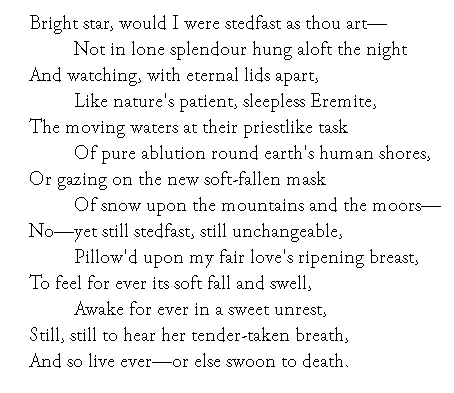
"Bright Star"
Line-by-Line Analysis
In this section, nosotros'll take a expect at each line in the poem more closely to examine its meaning and identify the poetic devices used in the piece.
Line i
The speaker addresses the star directly (it could be the North Star, Polaris) and contrasts the star's constancy with his own. He wishes he were as stedfast—steadfast in modern spelling—that is, fixed and without change. Hither, Keats is introducing the idea of nature vs. humanity, the star never changing in its appearance, and the homo—the private—just the opposite.
Lines 2 and three
But the speaker doesn't want to be out there on his own, watching, overlooking the world in isolation, eternally open-eyed (lids apart), without company of any sort. Note the enjambment—the 2d line running on into the third, maintaining the sense and momentum.
Lines 4, 5 and 6
The Eremite is a hermit, a Christian recluse. The speaker states clearly that this is not a conventional religious desire. He doesn't desire a Christian eternity, and he does not desire purification (ablution . . . in the ritualistic washing of the body sense).
Keats was not a regular churchgoing Christian and is generally known to accept had a 'lack of faith', hence the nickname Keats the pagan, which was not birthday fair or accurate. He was intensely religious—nature was his spiritual source—only did not practice conventional Christian beliefs.
Lines 7 and 8
The long sentence continues with a description of a snowy landscape, bringing to heed a cold, distant-if-idealistic visual. The speaker has no wish for this 'lone splendour'—at that place has to exist more than.
Line 9
The turn, or volta, occurs here. The speaker wants to be fixed and constant, but he as well wants to be with his love (Fanny Brawne), using her breasts as a pillow, sensing their move equally he lies awake forever in this restless state.
Lines 10–14
The linguistic communication here is patently ("for ever, ever"), reflecting the longing for an eternal loving human relationship. Either information technology must be or not. Death will be the outcome otherwise.
And so the speaker, the poet, in near desperation wishes to exist in love with his honey for all time. He wants to exist similar the star but tin can this ever be realised? Surely information technology's not on? Being human is all about being changeable, vulnerable and subject to the vagaries of the globe.
There are allusions to a sexual motive hither—the lover's chest, the sweetness unrest, the tender-taken breath, the swoon to expiry in pure orgasm? This seems unlikely, all the same, given Keats' own personal health and future prospects.
What Is The Metre (Meter) of "Bright Star"?
Bright Star has a bones iambic pentameter beat just has several lines that intermission the familiar daDUM stress pattern of the iambic, bringing varied rhythm and pace.
For instance, the kickoff pes of the start line is a spondee with double stress for stronger outcome at the start. And the second line begins with a trochee, or the starting time syllable stressed. Annotation in line 8 how an amphibrach and anapaest combine to produce a lilting rhythm that rises. This combination repeats in the last line to good effect.
Bright star, / would I / were sted / fast as / grand fine art—
Not in / lonely splen / bleak hung / aloft / the night
And watch / ing, with / eastwardter / nal lids / arole,
Like nat / ure's pat / ient, slumber / less E / remite,
The mov / ing wat / ers at / their priest / like job
Of pure / ablut / ion round / earth's hu / homo shores,
Or gaz / ing on / the new / soft-fall / en mask
Of snow / upon / the moun tains / and the moors—
No—nevertheless / still sted / fast, still / unchange / able,
Pillow'd / upon / my fair / love's ripen / ing breast,
To experience / for ev / er its / soft autumn / and swell,
Awake / for ev er / in a sweetness / unresidual,
However, all the same / to hear / her 10 / der-tak / en jiff,
And and then / alive ev er— / or else swoon / to decease.
What Are the Literary/Poetic Devices in "Brilliant Star"?
In this section, nosotros'll examine some of the poetic devices Keats employed in this Shakespearean sonnet.
Alliteration
Alliteration occurs when ii or more words beginning with consonants are close together in a line, affecting phonetics and adding texture and involvement. For instance:
"would I were," "mountains and the moors," "feel for ever its soft autumn and swell," "hear her tender-taken"
Caesura
Caesura occurs when a line has a break halfway, usually with punctuation. For example:
"Similar nature'southward patient, sleepless Eremite,"
Enjambment
Enjambment occurs when a line runs on into the next without punctuation, conveying sense and momentum, as in lines 2, v and 7.
© 2022 Andrew Spacey
Andrew Spacey (writer) from Sheffield, UK on August 11, 2020:
Thanks for the visit Ann. All proficient here so far.
Ann Carr from SW England on August eleven, 2020:
Interesting in-depth analysis every bit usual, Andrew. You always explicate things well. I'grand non a bang-up fan of the romantics just I come across the artistry in them.
Promise you're keeping well in this strange time!
Ann
Source: https://owlcation.com/humanities/Analysis-of-Poem-Bright-Star-by-John-keats
0 Response to "Bright Star Would I Were Stedfast as Thou Art Summary"
Postar um comentário