What Index Is Used to Measure the Average Prices Paid by a Typicalã¢â‚¬â€¹ Family

Consumer Toll Alphabetize
CPI
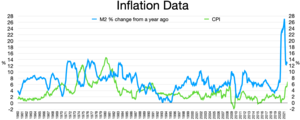
M2 % change from a year ago
CPI

A consumer price index (CPI) is a price index, the price of a weighted boilerplate market handbasket of consumer goods and services purchased past households. Changes in measured CPI track changes in prices over time.[1]
Overview [edit]
A CPI is a statistical gauge constructed using the prices of a sample of representative items whose prices are collected periodically. Sub-indices and sub-sub-indices can be computed for dissimilar categories and sub-categories of appurtenances and services, existence combined to produce the overall index with weights reflecting their shares in the total of the consumer expenditures covered past the index. It is one of several cost indices calculated by most national statistical agencies. The annual percentage modify in a CPI is used as a measure of inflation. A CPI can be used to alphabetize (i.e. adjust for the effect of aggrandizement) the existent value of wages, salaries, and pensions; to regulate prices; and to debunk monetary magnitudes to show changes in real values. In most countries, the CPI, along with the population census, is one of the most closely watched national economic statistics.


A graph of the US CPI from 1913 (in blue), and its percentage annual modify (in red)
The index is usually computed monthly, or quarterly in some countries, as a weighted boilerplate of sub-indices for different components of consumer expenditure, such as nutrient, housing, shoes, habiliment, each of which is, in turn, a weighted average of sub-sub-indices. At the almost detailed level, the elementary amass level, (for case, men's shirts sold in department stores in San Francisco), detailed weighting data is unavailable, so indices are computed using an unweighted arithmetic or geometric mean of the prices of the sampled production offers. (However, the growing use of barcode scanner information is gradually making weighting information bachelor even at the most detailed level.) These indices compare prices each month with prices in the price-reference calendar month. The weights used to combine them into the higher-level aggregates, and and then into the overall index, relate to the estimated expenditures during a preceding whole year of the consumers covered past the index on the products within its scope in the area covered. Thus the index is a stock-still-weight index, but rarely a true Laspeyres index, since the weight-reference period of a year and the price-reference menstruum, usually a more than recent single calendar month, practice not coincide.
Ideally, the weights would relate to the composition of expenditure during the time betwixt the price-reference month and the electric current month. There is a large technical economics literature on index formulas which would estimate this and which can be shown to approximate what economic theorists telephone call a true cost-of-living alphabetize. Such an index would show how consumer expenditure would take to move to compensate for price changes and then every bit to allow consumers to maintain a abiding standard of living. Approximations can only be computed retrospectively, whereas the index has to appear monthly and, preferably, quite soon. Withal, in some countries, notably in the United States and Sweden, the philosophy of the index is that it is inspired by and approximates the notion of a true cost of living (constant utility) index, whereas in virtually of Europe it is regarded more than pragmatically.
The coverage of the index may be limited. Consumers' expenditure away is usually excluded; visitors' expenditure within the land may be excluded in principle if not in do; the rural population may or may not be included; sure groups such every bit the very rich or the very poor may exist excluded. Saving and investment are ever excluded, though the prices paid for financial services provided by financial intermediaries may be included along with insurance.
The index reference period, usually chosen the base year, frequently differs both from the weight-reference period and the price-reference period. This is just a matter of rescaling the whole fourth dimension serial to make the value for the index reference-period equal to 100. Annually revised weights are a desirable but expensive feature of an index, for the older the weights the greater is the divergence betwixt the electric current expenditure design and that of the weight reference-menses.
It is calculated and reported on a per region or state basis on a monthly and annual basis. International organizations like the Organisation for Economic Co-operation and Evolution (OECD) report statistical figures similar the consumer cost index for many of its fellow member countries.[2] In the U.s.a. the CPI is normally reported by the Bureau of Labor Statistics.[three] [4] [five]
An English economist by the name of Joseph Lowe first proposed the theory of price handbasket alphabetize in 1832. His fixed basket approach was relatively uncomplicated as Lowe computed the price of a listing of appurtenances in period 0 and compared the price of that same basket of appurtenances in menstruation 1. Since his proposed theories however were unproblematic, later economists congenital on his ideas to form our modern definition.[6]
Calculating the CPI for a single item [edit]

or
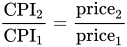
- Where 1 is commonly the comparison year and CPIane is usually an index of 100.
Alternatively, the CPI can be performed as . The "updated toll" (i.e. the price of an item at a given twelvemonth, due east.g.: the toll of bread in 2018) is divided past that of the initial year (the price of bread in 1970), then multiplied past one hundred.[7]

Calculating the CPI for multiple items [edit]
Many only non all price indices are weighted averages using weights that sum to 1 or 100.
Case: The prices of 85,000 items from 22,000 stores, and 35,000 rental units are added together and averaged. They are weighted this style: housing 41.four%; nutrient and beverages 17.four%; transport 17.0%; medical care 6.9%; apparel six.0%; entertainment 4.4%; other vi.9%. Taxes (43%) are not included in CPI computation.[8]
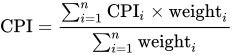
where the terms practise non necessarily sum to 1 or 100.

Weighting [edit]
Weights and sub-indices [edit]
Past convention, weights are fractions or ratios summing to ane, as percentages summing to 100 or every bit per mille numbers summing to m.[ citation needed ]
On the European Marriage'south Harmonized Index of Consumer Prices (HICP), for instance, each country computes some 80 prescribed sub-indices, their weighted average constituting the national HICP. The weights for these sub-indices volition consist of the sum of the weights of a number of component lower level indices. The classification is according to use, adult in a national accounting context. This is not necessarily the kind of nomenclature that is nearly appropriate for a consumer price index. Grouping together of substitutes or of products whose prices tend to move in parallel might be more suitable.
For some of these lower-level indices detailed reweighing to make them be available,[ clarification needed ] allowing computations where the individual price observations tin can all be weighted.[ clarification needed ] This may be the instance, for example, where all selling is in the hands of a single national arrangement which makes its data available to the index compilers. For virtually lower level indices, notwithstanding, the weight will consist of the sum of the weights of a number of elementary amass indices, each weight respective to its fraction of the total annual expenditure covered by the index. An 'simple aggregate' is a everyman-level component of expenditure: this has a weight, but the weights of each of its sub-components are unremarkably lacking. Thus, for example: Weighted averages of elementary aggregate indices (e.g. for men'due south shirts, raincoats, women's dresses, etc.) make upwardly depression-level indices (e.g. outer garments).
Weight averages of these, in turn, provide sub-indices at a higher, more aggregated level (e.1000. vesture) and weighted averages of the latter provide yet more than aggregated sub-indices (e.1000. Clothing and Footwear).
Some of the elementary amass indices and some of the sub-indices can be defined only in terms of the types of appurtenances and/or services they comprehend. In the example of such products as newspapers in some countries and postal services, which have nationally uniform prices.[ clarification needed ] [ words missing? ] But where price movements do differ or might differ between regions or between outlet types, separate regional and/or outlet-type elementary aggregates are ideally required for each detailed category of goods and services, each with its own weight. An example might be an elementary aggregate for sliced bread sold in supermarkets in the Northern region.
Most simple aggregate indices are necessarily 'unweighted' averages for the sample of products within the sampled outlets. However, in cases where it is possible to select the sample of outlets from which prices are collected so as to reflect the shares of sales to consumers of the different outlet types covered, self-weighted simple amass indices may be computed. Similarly, if the market shares of the different types of products represented by product types are known, even just approximately, the number of observed products to be priced for each of them tin exist made proportional to those shares.
Estimating weights [edit]
The outlet and regional dimensions noted above hateful that the estimation of weights involves a lot more than than just the breakup of expenditure by types of appurtenances and services, and the number of separately weighted indices composing the overall index depends upon two factors:
- The degree of detail to which available data permit breakdown of total consumption expenditure in the weight reference-period by type of expenditure, region and outlet type.
- Whether there is reason to believe that toll movements vary between these most detailed categories.
How the weights are calculated, and in how much detail, depends upon the availability of information and upon the scope of the index. In the United kingdom of great britain and northern ireland the retail toll index (RPI)[nine] does not chronicle to the whole of consumption, for the reference population is all private households with the exception of pensioner households that derive at least three-quarters of their full income from state pensions and benefits, and "high income households" whose total household income lies within the top 4 per cent of all households. The result is that it is difficult to use information sources relating to total consumption by all population groups.
For products whose toll movements can differ between regions and betwixt different types of outlet:
- The platonic, rarely realizable in practice, would consist of estimates of expenditure for each detailed consumption category, for each type of outlet, for each region.
- At the opposite extreme, with no regional information on expenditure totals but merely on population (east.g. 24% in the Northern region) and only national estimates for the shares of different outlet types for broad categories of consumption (east.thousand. 70% of food sold in supermarkets) the weight for sliced staff of life sold in supermarkets in the Northern region has to be estimated equally the share of sliced breadstuff in full consumption × 0.24 × 0.7.
The situation in most countries comes somewhere between these two extremes. The point is to brand the best use of whatever data are available.
The nature of the data used for weighing [edit]
No firm rules can be suggested on this outcome for the simple reason that the available statistical sources differ between countries. Yet, all countries deport journal household-expenditure surveys and all produce breakdowns of consumption expenditure in their national accounts. The expenditure classifications used at that place may nonetheless be different. In particular:
- Household-expenditure surveys exercise non cover the expenditures of foreign visitors, though these may be within the scope of a consumer price index.
- National accounts include imputed rents for possessor-occupied dwellings which may not be within the scope of a consumer toll index.
Even with the necessary adjustments, the national-account estimates and household-expenditure surveys usually diverge.
The statistical sources required for regional and outlet-blazon breakdowns are usually weak. Simply a large-sample Household Expenditure survey can provide a regional breakdown. Regional population data are sometimes used for this purpose, only demand adjustment to allow for regional differences in living standards and consumption patterns. Statistics of retail sales and market research reports tin provide information for estimating outlet-type breakdowns, but the classifications they use rarely stand for to COICOP categories.
The increasingly widespread use of bar codes, scanners in shops has meant that detailed cash annals printed receipts are provided by shops for an increasing share of retail purchases. This evolution makes possible improved Household Expenditure surveys, as Statistics Republic of iceland has demonstrated. Survey respondents keeping a diary of their purchases demand to record but the total of purchases when itemized receipts were given to them and keep these receipts in a special pocket in the diary. These receipts provide not only a detailed breakdown of purchases but also the proper noun of the outlet. Thus response burden is markedly reduced, accuracy is increased, product description is more specific and signal of purchase data are obtained, facilitating the interpretation of outlet-type weights.
At that place are just two general principles for the estimation of weights: use all the bachelor information and have that rough estimates are better than no estimates.
Reweighing [edit]
Ideally, in calculating an index, the weights would represent current annual expenditure patterns. In exercise, they necessarily reflect past using the most recent information available or, if they are not of loftier quality, some average of the data for more ane previous year. Some countries have used a three-year boilerplate in recognition of the fact that household survey estimates are of poor quality. In some cases, some of the data sources used may not be available annually, in which case some of the weights for lower-level aggregates within higher-level aggregates are based on older data than the higher level weights.
Infrequent reweighing saves costs for the national statistical function but delays the introduction into the index of new types of expenditure. For case, subscriptions for Internet service entered index compilation with a considerable time lag in some countries, and account could be taken of digital camera prices between re-weightings only by including some digital cameras in the same elementary aggregate as picture show cameras.
Possessor-occupiers and the cost index [edit]
The way in which possessor-occupied dwellings should exist dealt with in a consumer price alphabetize has been, and remains, a subject of heated controversy in many countries. Various approaches accept been considered, each with their advantages and disadvantages.[ commendation needed ]
The economists' approach [edit]
Leaving aside the quality of public services, the surround, crime so forth, and regarding the standard of living as a office of the level and composition of individuals' consumption, this standard depends upon the amount and range of goods and services they swallow. These include the service provided past rented accommodation, which tin can readily be priced, and the similar services yielded by a apartment or business firm owned by the consumer who occupies it. Its price to a consumer is, according to the economic way of thinking, an "opportunity cost", namely what he or she sacrifices past living in it. This cost, according to many economists, is what should form a component of a consumer price index.
Opportunity cost can exist looked at in two ways, since there are 2 alternatives to continuing to live in an owner-occupied dwelling. One – supposing that it is one yr'due south cost that is to exist considered – is to sell it, earn interest on the owner's upper-case letter thus released, and purchase information technology back a year later on, making an assart for its concrete depreciation. This can exist called the "alternative cost" arroyo. The other, the "rental equivalent" approach, is to let information technology to someone else for the yr, in which instance the price is the rent that could be obtained for it.
There are practical problems in implementing either of these economists' approaches. Thus, with the alternative cost approach, if house prices are rising fast the cost can be negative and and then get sharply positive once house prices first to fall, and so such an index would be very volatile. On the other manus, with the rental equivalent approach, in that location may be difficulty in estimating the movement of rental values of types of property that are not really rented. If 1 or other of these measures of the consumption of the services of owner-occupied dwellings is included in consumption, so it must be included in income also, for income equals consumption plus saving. This means that if the movement of incomes is to be compared with the movement of the consumer cost index, incomes must be expressed as money income plus this imaginary consumption value. That is logical, but it may not be what users of the index want.
Although the argument has been expressed in connection with owner-occupied dwellings, the logic applies equally to all durable consumer appurtenances and services. Furniture, carpets and domestic appliances are not used up soon later purchase in the mode that food is. Like dwellings, they yield a consumption service that can keep for years. Furthermore, since strict logic is to exist adhered to, there are durable services every bit well that ought to exist treated in the aforementioned fashion; the service consumers derive from appendectomies or crowned teeth go on for a long fourth dimension. Since estimating values for these components of consumption has not been tackled, economical theorists are torn between their desire for intellectual consistency and their recognition that inclusion of the opportunity toll of the use of durables is impracticable.[ citation needed ]
Spending [edit]
Some other approach is to concentrate on spending. Everyone agrees that repairs and maintenance expenditure of possessor-occupied dwellings should be covered in a consumer toll index, but the spending approach would include mortgage involvement too. This turns out to be quite complicated, conceptually besides every bit in do.
To explicate what is involved, consider a consumer cost alphabetize computed with reference to 2009 for just one sole consumer who bought her house in 2006, financing one-half of this sum by raising a mortgage. The problem is to compare how much interest such a consumer would now be paying with the involvement that was paid in 2009. Since the aim is to compare similar with like, that requires an estimate of how much interest would be paid now in the year 2010 on a similar house bought and 50% mortgage-financed three years ago, in 2007. Information technology does non require an estimate of how much that identical person is paying now on the actual business firm she bought in 2006, even though that is what personally concerns her at present.
A consumer price alphabetize compares how much it would cost now to do exactly what consumers did in the reference-flow with what it cost and then. Application of the principle thus requires that the alphabetize for our i firm possessor should reflect the motion of the prices of houses like hers from 2006 to 2007 and the change in involvement rates. If she took out a fixed-interest charge per unit mortgage it is the modify in interest rates from 2006 to 2007 that counts; if she took out a variable interest mortgage it is the change from 2009 to 2010 that counts. Thus her electric current alphabetize with 1999 as reference-menstruum will stand up at more than 100 if house prices or, in the example of a fixed-interest mortgage, interest rates rose between 2006 and 2007.
The application of this principle in the owner-occupied dwellings component of a consumer price index is known equally the "debt profile" method. It means that the current motility of the index will reflect past changes in habitation prices and involvement rates. Some people regard this as odd. Quite a few countries utilise the debt profile method, but in doing so most of them behave inconsistently. Consistency would crave that the index should also cover the involvement on consumer credit instead of the whole price paid for the products bought on credit if it covers mortgage interest payments. Products bought on credit would and then be treated in the same way equally possessor-occupied dwellings.
Variants of the debt profile method are employed or have been proposed. One instance is to include down payments too equally interest. Some other is to correct nominal mortgage rates for changes in dwelling prices or for changes in the rest of the consumer toll alphabetize to obtain a "existent" rate of involvement. Too, other methods may be used alongside the debt profile method. Thus several countries include a purely notional toll of depreciation as an additional index component, applying an arbitrarily estimated, or rather guessed, depreciation rate to the value of the stock of owner-occupied dwellings. Finally, one country includes both mortgage interest and purchase prices in its index.
Transaction prices [edit]
The third approach simply treats the acquisition of possessor-occupied dwellings in the same way as acquisitions of other durable products are treated. This ways:
- Taking business relationship of the transaction prices agreed;
- Ignoring whether payments are delayed or are partly financed by borrowing;
- Leaving out second-mitt transactions. Second-hand purchases stand for to sales past other consumers. Thus just new dwellings would be included.
Furthermore, expenditure on enlarging or reconstructing an owner-occupied dwelling would be covered, in add-on to regular maintenance and repair. Two arguments of an almost theological grapheme are advanced in connection with this transactions arroyo.
One statement is that purchases of new dwellings are treated as 'investment' in the organisation of national accounts, so should not enter a consumption toll index. It is said that this is more than than but a thing of terminological uniformity. For example, it may exist idea to help understanding and facilitate economical analysis if what is included under the heading of 'consumption' is the same in the consumer cost alphabetize and in the national income and expenditure accounts. Since these accounts include the equivalent rental value of owner-occupied dwellings, the equivalent rental approach would have to be applied in the consumer price index as well. But the national accounts do not utilise information technology to other durables, and then the statement demands consistency in 1 respect but accepts its rejection in another.
The other argument is that the prices of new dwellings should exclude that part reflecting the value of the land, since this is an irreproducible and permanent asset that cannot exist said to be consumed. This would presumably mean deducting site value from the price of a dwelling, site value presumably being divers every bit the price the site would fetch at auction if the dwelling were not on it. How this is to exist understood in the case of multiple dwellings remains unclear.[ citation needed ]
Defoliation [edit]
The merits of the different approaches are multidimensional, including feasibility, views on the way the index should and would movement in particular circumstances, and theoretical properties of the index.
Statisticians in a country lacking a practiced home price index (which is required for all except the rental equivalent method) will continue with a proposal to use such an index only if they can obtain the necessary boosted resources that volition enable them to compile one. Even obtaining mortgage interest rate data can be a major job in a land with a multitude of mortgage lenders and many types of mortgage. Dislike of the issue upon the beliefs of the consumer toll index arising from the adoption of some methods can exist a powerful, if sometimes unprincipled, argument.
Dwelling prices are volatile and and so, therefore, would exist an alphabetize incorporating the current value of a dwelling price sub-alphabetize which, in some countries, would have a large weight under the third approach. Furthermore, the weight for possessor-occupied dwellings could be altered considerably when reweighting was undertaken. (It could even get negative under the alternative cost approach if weights were estimated for a year during which house prices had been rising steeply).
So, in that location is the point that a ascension in interest rates designed to halt aggrandizement could paradoxically brand inflation appear higher if electric current involvement rates showed up in the index. Economists' principles are not acceptable to all; nor is insistence upon consistency between the treatment of possessor-occupied dwellings and other durables.
Consumer toll indices in the The states [edit]

CPI inflation reaching vii% using current methods vs 15% inflation using the 1980s methodology.
In the United States several different consumer price indices are routinely computed by the Agency of Labor Statistics (BLS). These include the CPI-U (for all urban consumers), CPI-Westward (for Urban Wage Earners and Clerical Workers), CPI-E (for the elderly), and C-CPI-U (chained CPI for all urban consumers). These are all congenital over ii stages. First, the BLS collects information to estimate 8,018 separate particular–area indices reflecting the prices of 211 categories of consumption items in 38 geographical areas. In the second phase, weighted averages are computed of these 8,018 item–expanse indices. The different indices differ simply in the weights practical to the different 8,018 detail–area indices. The weights for CPI-U and CPI-W are held constant for 24 months, irresolute in January of even-numbered years. The weights for C-CPI-U are updated each calendar month to reflecting changes in consumption patterns in the concluding month. Thus, if people on average consume more chicken and less beef or more than apples and fewer oranges than the previous month, that change would be reflected in next calendar month'south C-CPI-U. Nevertheless, information technology would not exist reflected in CPI-U and CPI-W until January of the adjacent even-numbered year.[10]
This allows the BLS to compute consumer price indices for each of the designated 38 geographical areas and for aggregates like the Midwest.[11]
In January of each yr, Social Security recipients receive a price-of-living adjustment (COLA) "to ensure that the purchasing power of Social Security and Supplemental Security Income (SSI) benefits is not eroded by inflation. It is based on the percentage increase in the Consumer Price Index for Urban Wage Earners and Clerical Workers (CPI-W)".[12] The use of CPI-W conflicts with this purpose, because the elderly consume essentially more than wellness care goods and services than younger people.[xiii] In recent years, inflation in health care has substantially exceeded aggrandizement in the rest of the economy. Since the weight on health care in CPI-W is much less than the consumption patterns of the elderly, this COLA does not adequately recoup them for the real increases in the costs of the items they buy.
The BLS does runway a consumer price alphabetize for the elderly (CPI-E). It is not used, in part because the social security trust fund is forecasted to run out of coin in roughly twoscore years, and using the CPI-E instead of CPI-W would shorten that past roughly 5 years.[fourteen]
The most recent December 2021 CPI reading hitting vii%, the highest level in over 40 years. According to methods used in the 1980s CPI is closer to 15%. In response Jerome Powell, chair of the Federal Reserve has begun Quantitative tightening with rate hikes expected to begin in March 2022.[15] [xvi] [17] [18]
History [edit]
The CPI for various years are listed beneath with 1982 as the base year:[19] A CPI of 150 means that at that place was l% increment in prices, or 50% inflation, since 1982.
| Year | CPI |
|---|---|
| 1920 | twenty.0 |
| 1930 | 16.7 |
| 1940 | fourteen.0 |
| 1950 | 24.1 |
| 1960 | 29.6 |
| 1970 | 38.viii |
| 1980 | 82.4 |
| 1982 | 100 |
| 1990 | 130.7 |
| 2000 | 172.two |
| 2010 | 219.two |
| 2018 | 251.1 |
Chained CPI [edit]
Sometime White House Chief of Staff Erskine Bowles and quondam U.S. Senator Alan K. Simpson suggested a transition to using a "chained CPI" in 2010, when they headed the White House'due south arrears-reduction committee.[20] They stated that it was a more accurate measure of inflation than the electric current system and switching from the current system could save the government more than $290 billion over the decade following their report.[twenty] "The chained CPI is usually 0.25 to 0.30 per centum points lower each year, on average, than the standard CPI measurements".[twenty]
However, the National Active and Retired Federal Employees Associations said that the chained CPI does not business relationship for seniors citizens' health care costs.[20] Robert Reich, erstwhile Usa Secretary of Labor nether President Clinton, noted that typical seniors spend betwixt 20 and 40 per centum of their income on health care, far more than most Americans. "Besides, Social Security isn't in serious trouble. The Social Security trust fund is affluent for at least two decades. If we want to ensure information technology's at that place across that, there'southward an easy ready – just lift the ceiling on income subject to Social Security taxes, which is at present $113,700."[xiii]
Replacing the current cost-of-living adjustment calculation with the chained CPI was considered, but not adopted, equally part of a deficit-reduction proposal to avert the sequestration cuts, or fiscal cliff, in January 2013,[twenty] but President Obama included it in his April 2013 upkeep proposal.[21]
Personal consumption expenditures price alphabetize [edit]


Because of some shortcomings of the CPI, notably that information technology uses static expenditure weighting and information technology does not account for the exchange consequence, the PCEPI is an alternative price index used past the Federal Reserve, amid others, to mensurate inflation.[22] From January 1959 through July 2018, inflation measured past the PCEPI has averaged iii.3%, while it has averaged 3.8% using CPI.[23]
See likewise [edit]
- Consumer price index by state
- Asset price inflation
- Core inflation
- Cost of living index
- FRED (Federal Reserve Economic Information)
- Harmonized Alphabetize of Consumer Prices (HICP)
- Hedonic regression
- Higher Education Price Alphabetize
- Household final consumption expenditure (HFCE)
- Gdp deflator
- Aggrandizement aligning
- Inflation hedge
- Inflation charge per unit
- Inflationism
- List of economic science topics
- Market place basket (basket of goods)
- MIT Billion Prices project
- Personal consumption expenditures toll index (PCEPI)
- Producer price index (PPI)
- Quality bias
- RPIX
- World inflation crunch
References [edit]
- ^ "CONSUMER PRICE INDEX". OECD. Retrieved September 13, 2019.
- ^ "Inflation (Consumer Price Index)". OECD. Retrieved September 12, 2019.
- ^ "Consumer Price Index". U.S. Agency of Labor Statistics. Retrieved September 13, 2019.
- ^ "The Consumer Price Index" (PDF). U.S. Agency of Labor Statistics. Retrieved September 13, 2019.
- ^ "Consumer Price Index Ofttimes Asked Questions". U.S. Agency of Labor Statistics. Retrieved September xiii, 2019.
- ^ The new Palgrave dictionary of economics (Living ed.). London. 2019. ISBN978-1-349-95121-v. OCLC 1111663693.
- ^ Educational activity 2020 Homeschool Console, subject Economics, lecture "Inflation". Formula described within.
- ^ Bloomberg Business organization News, Social Security Administration
- ^ "Retail Price Index (RPI) Definition".
- ^ "Frequently Asked Questions nearly the Chained Consumer Price Index for All Urban Consumers (C-CPI-U)". Consumer Price Alphabetize. Bureau of Labor Statistics. Retrieved Apr eleven, 2013.
For example, the CPI-U for the years 2004 and 2005 uses expenditure weights drawn from the 2001–2002 Consumer Expenditure Surveys.
- ^ "Consumer Price Index, Portland – Second Half 2012". Consumer Cost Index. Bureau of Labor Statistics. Retrieved April 11, 2013. "Midwest Region Consumer Price Index – February 2013". Consumer Toll Index. Agency of Labor Statistics. Retrieved April xi, 2013.
- ^ "Price-Of-Living Adjustment (COLA) Information For 2013". Cost-Of-Living Adjustment. Social Security Administration. Retrieved April 11, 2013.
- ^ a b Robert, Reich (Apr 4, 2013). "What'due south the 'Chained CPI,' Why It'due south Bad for Social Security and Why the White Firm Shouldn't Be Touting It (VIDEO)". HuffPost . Retrieved April 11, 2013.
- ^ Hobijn, Bart; Lagakos, David (May 2003). "Social Security and the Consumer Toll Index for the Elderly". Current Issues in Economics and Finance. Federal Reserve Banking concern of New York. 9 (five): 1–vi. Retrieved April xi, 2013.
- ^ Egan, Matt (January 15, 2022). "Jerome Powell's pitch for a 2d term: America can't beget runaway inflation". CNN.
- ^ Timiraos, Nick (January fifteen, 2022). "Fed'southward Powell Says Economic system No Longer Needs Ambitious Stimulus". WSJ.
- ^ Aratani, Lauren (January 15, 2022). "U.s. inflation reached seven% in Dec as prices rise at rates unseen in decades". The Guardian.
- ^ Giustra, Frank (January fifteen, 2022). "Is the U.S. purposely under-reporting inflation? It'southward hard not to wonder when yous look at how it's calculated". Toronto Star.
- ^ "Consumer Toll Index Data from 1913 to 2019". Consumer Price Alphabetize (CPI) Databases. U.s.a. Department of Labor. Retrieved 23 Apr 2019.
- ^ a b c d eastward Losey, Stephen (31 December 2012). "Chained CPI proposal off table for now, lawmakers say". Federal Times . Retrieved 3 January 2013.
- ^ Gibson, Ginger (April 9, 2013). "Republicans applaud chained CPI in Obama budget". Politico . Retrieved April 11, 2013.
- ^ "The Fed - What is inflation and how does the Federal Reserve evaluate changes in the rate of inflation?". Retrieved nine September 2018.
- ^ PCE and CPI indices, Jan 1959 - Jul 2018: "FRED Graph - FRED - St. Louis Fed". fred.stlouisfed.org . Retrieved 9 September 2018.
Further reading [edit]
- W. E. Diewert, 1993. "The early on history of price index research". Chapter two of Essays in Alphabetize Number Theory, Volume I, Westward. E. Diewert and A. O. Nakamura, editors. Elsevier Science Publishers, B.Five. doi:x.3386/w2713
External links [edit]
- Consumer Price Index Data
- Issues of the Consumer Price Alphabetize report from the BLS for 1953–present
- ILO CPI manual – This big manual produced co-operatively past a number of international organizations is the standard work on the methods of compiling consumer price indices and on the underlying economic and statistical theory.
- BLS rebuttal to SGS CPI calculation criticisms
Source: https://en.wikipedia.org/wiki/Consumer_price_index
0 Response to "What Index Is Used to Measure the Average Prices Paid by a Typicalã¢â‚¬â€¹ Family"
Postar um comentário